
What Is A Vascular Occlusion?
Filler has entered or compressed a blood vessel and the tissue that vessel supplies is no longer getting blood.
It is rare — and it is also the reason this page is written bluntly rather than reassuringly, because the outcome depends almost entirely on how fast somebody acts, and the person best placed to notice is you.
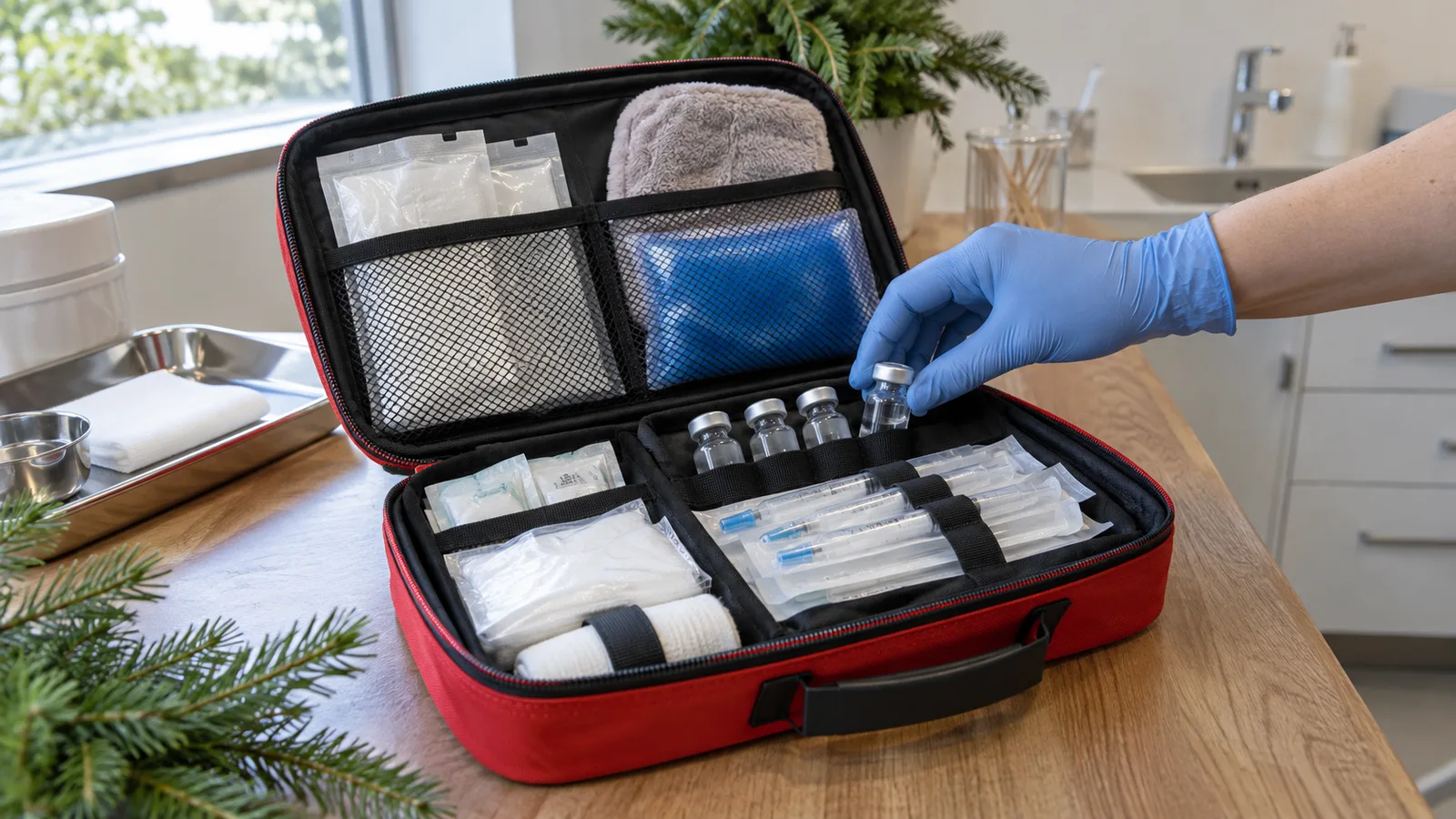
Recognising it
Pain that doesn't behave like injection pain. This is the first and most reliable signal. Ordinary discomfort fades as you leave the chair. Occlusion pain is disproportionate, it persists, and frequently it worsens over the following minutes or hours. Severe pain after filler is never something to wait out at home.
Colour that changes and stays changed. The area may drain to a dull white, sometimes only a patch of it. Or it goes the other way into a dusky, greyish, net-like mottling across the skin. Either direction is significant. What distinguishes it from the ordinary pallor around a fresh injection is that it doesn't recover.
Slow refill. Press the area and let go. Colour that takes noticeably longer than the skin beside it to return is a concrete sign rather than an impression.
Cold skin over the affected patch, compared against the other side of your face.
Later: swelling, pustules, and a darkening crust as tissue begins to die. By this stage you are already well past the point where it should have been treated.
There is one variant that must be treated as an emergency in its own right. Any change in vision after filler, whether blurring, a field going dark, or pain behind the eye, requires immediate hospital care rather than a call to the clinic. This is vanishingly rare and it is not something to interpret at home.
What to do
Contact the injector at once, by telephone, and describe the pain and the colour. Do not send a message and wait. Do not go to sleep on it.
The treatment for hyaluronic acid filler is hyaluronidase, in quantity, promptly, often repeated. A practice equipped for this keeps it on the premises and has a protocol. Hours count. Treated within two, most people recover completely; left for two days, scarring becomes the likely outcome.
If you cannot reach the person who treated you, go to an emergency department. Take the product packaging or its name if you have it.
Warmth and gentle massage over the area are commonly advised while you're arranging care. They are supportive measures and not a substitute for anything.
Reducing the risk beforehand
This is a complication of anatomy and technique, which means the choice of injector is most of your risk management.
Ask, before any filler goes in, what their protocol is for a suspected occlusion and whether hyaluronidase is in the building. Ask it as a straightforward question. A practice that has planned for this answers in one fluent sentence, and the quality of that answer is one of the more informative things you will learn in a consultation.
Favour hyaluronic acid products until you know your face, precisely because they can be dissolved. Products that cannot be reversed remove your main safety net.
Understand that some regions carry more risk than others: the area between the brows, the nose, and the space around the nasolabial fold. Treatment there deserves an experienced clinician rather than a convenient one.
And be reachable afterwards. Don't have filler placed the day before you travel somewhere without decent medical access.
Keeping it in proportion
Most people who have filler never encounter this, and the point of the page isn't to frighten you out of treatment. It's that the cost of knowing is fifteen minutes of reading, and the cost of not knowing, on the rare occasion it matters, is permanent.
Proximity is worth real money here too. Being able to get back into the room inside an hour is a genuine argument for choosing a practice you can reach quickly over one you can reach eventually.
If you want the clinical literature rather than a summary, database access through the West New York Free Public Library System will get you there, as will an institutional login from somewhere like Stevens Institute of Technology.
Two administrative notes, since people ask. Confirming a practice is a registered, contactable business is what a directory such as the Hudson County Chamber of Commerce is for.
A local roll like the North Jersey Chamber of Commerce does the same job for businesses on this side. Neither tells you whether anyone there can manage an occlusion, and that question goes to the clinic, out loud, before you book.