
Which Chemical Peel Is Best For Dark Spots?
Wrong first question — try again. Naming the cause comes before naming the acid, because the three common causes want different depths and one of them punishes aggression badly.
Get this wrong and you don't simply waste money. You can darken the exact thing you were trying to lighten.
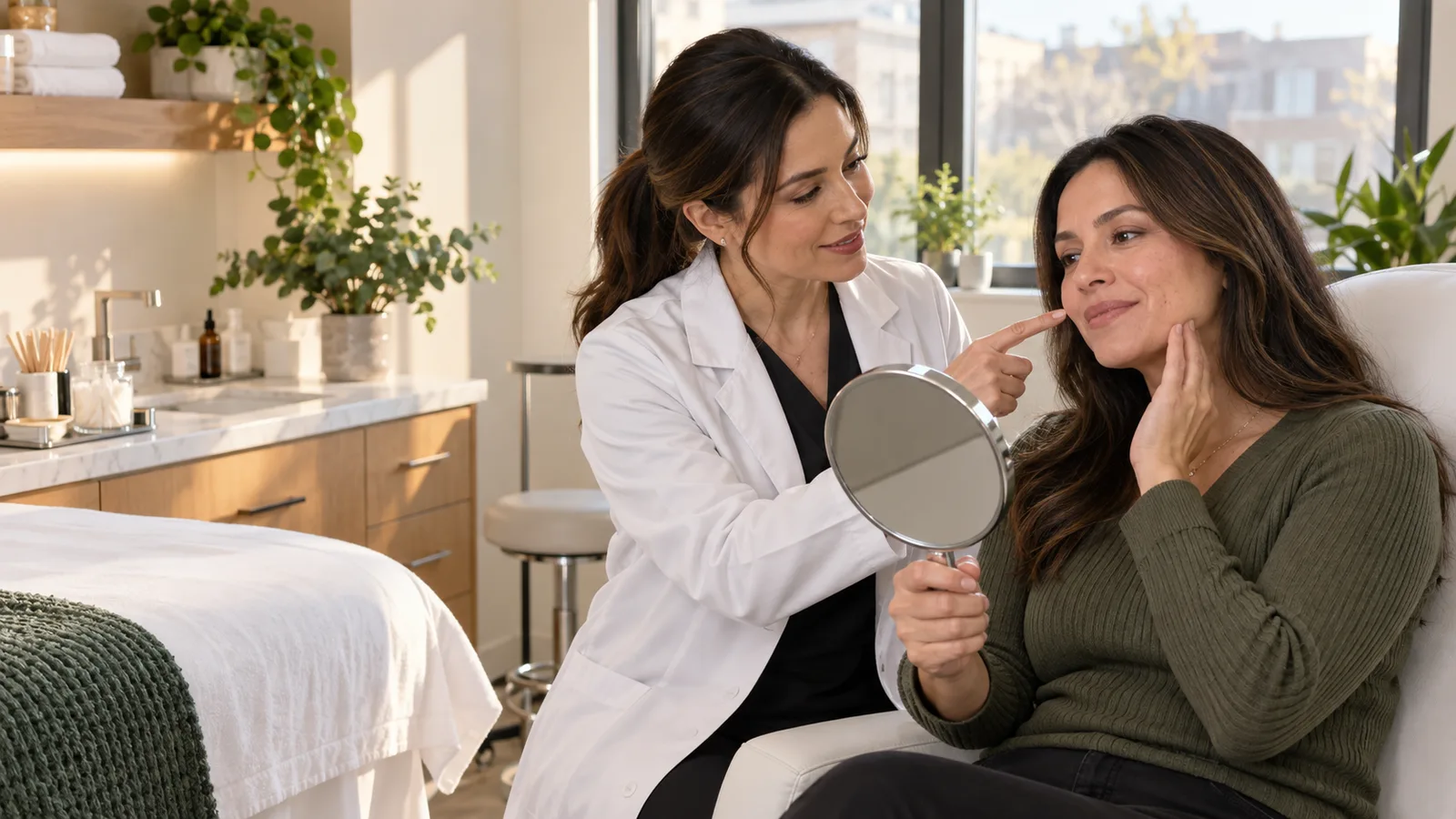
Name the cause first
Sun spots. Flat brown patches with defined edges, on the areas that catch the most light: forehead, upper cheeks, nose, the backs of the hands. They accumulate with age and exposure. These respond best of the three.
Melasma. Larger, softer-edged, roughly symmetrical patches, typically across the cheeks, forehead and upper lip. Driven by hormones and made worse by heat and light. It fluctuates, it returns, and it does not like being treated forcefully.
Post-inflammatory pigmentation. A mark left where something happened: a spot, a scratch, an ingrown hair, a previous treatment. It follows the shape of the original injury and it fades on its own, slowly.
If you're unsure, that uncertainty is itself the reason to be assessed rather than to buy a peel. The three look more alike in a mirror than they do under proper examination.
What actually gets used
Superficial acids are the workhorses. Glycolic at moderate strength, lactic for sensitive or drier skin, mandelic where the skin tone is deeper and the risk of rebound is higher. Salicylic where congestion is part of the picture. These run as courses, commonly four to six appointments with two or three weeks between, and they're the sensible starting point for every one of the three causes.
Combination formulations layer several acids at low individual strengths, which allows a reasonable effect with a shorter recovery. Widely used for pigment.
Trichloroacetic acid at medium depth does considerably more per session for sun damage. It also carries genuine downtime and real risk in the wrong hands or the wrong skin, and it is a poor first move for melasma.
The acid matters less than the depth and the operator's judgment about your skin. Anyone naming a product before examining you is selling from a menu.
Skin tone changes the answer
The deeper your natural pigment, the more readily your skin responds to injury by making more pigment. That's the mechanism behind post-inflammatory darkening, and it means aggressive treatment carries a real chance of leaving you worse off.
For deeper skin tones the correct approach is conservative: gentler acids, lower concentrations, more sessions, longer preparation beforehand. A practitioner experienced with your skin type is not a nicety here, it's the main safety variable. Ask directly how often they treat skin like yours.
Priming is where most of the result comes from anyway. Several weeks of a pigment-suppressing regimen before the first peel does more for the outcome than moving up a strength.
Light is not optional here
This is the part people skip and it decides everything.
Pigment is a light-driven process. Treating it while continuing normal unprotected exposure means you're removing pigment at one end and manufacturing it at the other. Melasma in particular will rebound completely.
Daily broad-spectrum protection, reapplied, with a hat, for the duration and well beyond it. On an open eastern slope with the river reflecting at you, add the underside of the jaw and the neck to the areas you cover, because that's where reflected light lands.
Consider the season too. Starting a pigment course in late autumn gives you months of lower exposure to consolidate, and the same work started in June is fighting itself. Seasonal outlooks from the National Weather Service are a better planning input than a guess about what the summer will do.
A sensible order of steps
Get the diagnosis. Start with the gentlest thing that could work. Prime properly for weeks beforehand. Protect obsessively. Photograph monthly in consistent light, because pigment changes too slowly to judge from memory.
And be realistic about melasma specifically: it's managed, not cured, and anybody promising otherwise is describing an outcome they cannot deliver.
For the underlying evidence on peel depth and post-inflammatory pigmentation, the West New York Free Public Library System will get you into the journals rather than the marketing.
And municipal listings through the Town of West New York will tell you which practices are registered to trade locally, which is the administrative half of vetting. The clinical half happens in the room.